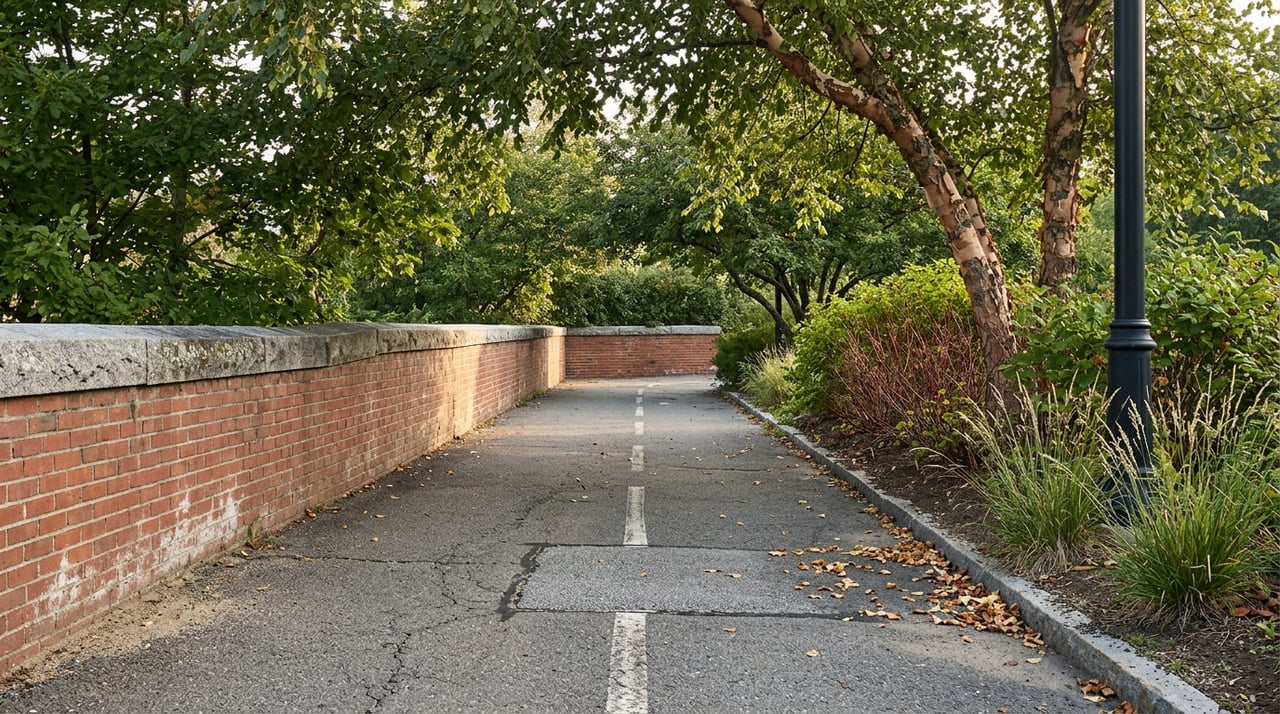
Start at Kennedy Park and walk two blocks. You will pass Victorian houses the whole way, porches and gables from roughly the same twenty-year stretch of the 1890s and 1900s. Nothing about the walk announces that you have crossed into different legal territory. But by the time you reach Fairfield Avenue, you have. On one side of that line, a homeowner can repaint a porch rail or swap a window sash without asking anyone. On the other, the same project goes in front of a city commission first.
Most people who live in the Highlands could not tell you where that line falls, or that it exists at all. It is worth knowing, because it is not a quirk of paperwork. It is the clearest evidence that this one neighborhood actually contains two different neighborhoods, built in the same years by different kinds of money, and only one of them was ever protected as a whole.
Kennedy Park sits where the schoolyard used to be
The Highlands took its name late. The area was first known as Manchester Grounds, platted by a group of landowners from Manchester, New Hampshire not long after Holyoke was chartered in 1852, and those original holders had defaulted on the land by 1856. It was not until 1897 that the neighborhood was renamed for its higher elevation at the foot of the Mount Tom range, the name that stuck. Today the Highlands covers roughly 400 acres of mostly residential streets, and Kennedy Park is one of its two named public parks.
Kennedy Park itself sits on the former site of Highland Grammar School, a three-story building put up in 1905 to serve a neighborhood that was filling in faster than the city could keep up with. The park now spans a single city block and holds a children's playscape, a 60-foot ball diamond, and an open patch big enough for a pickup soccer game.
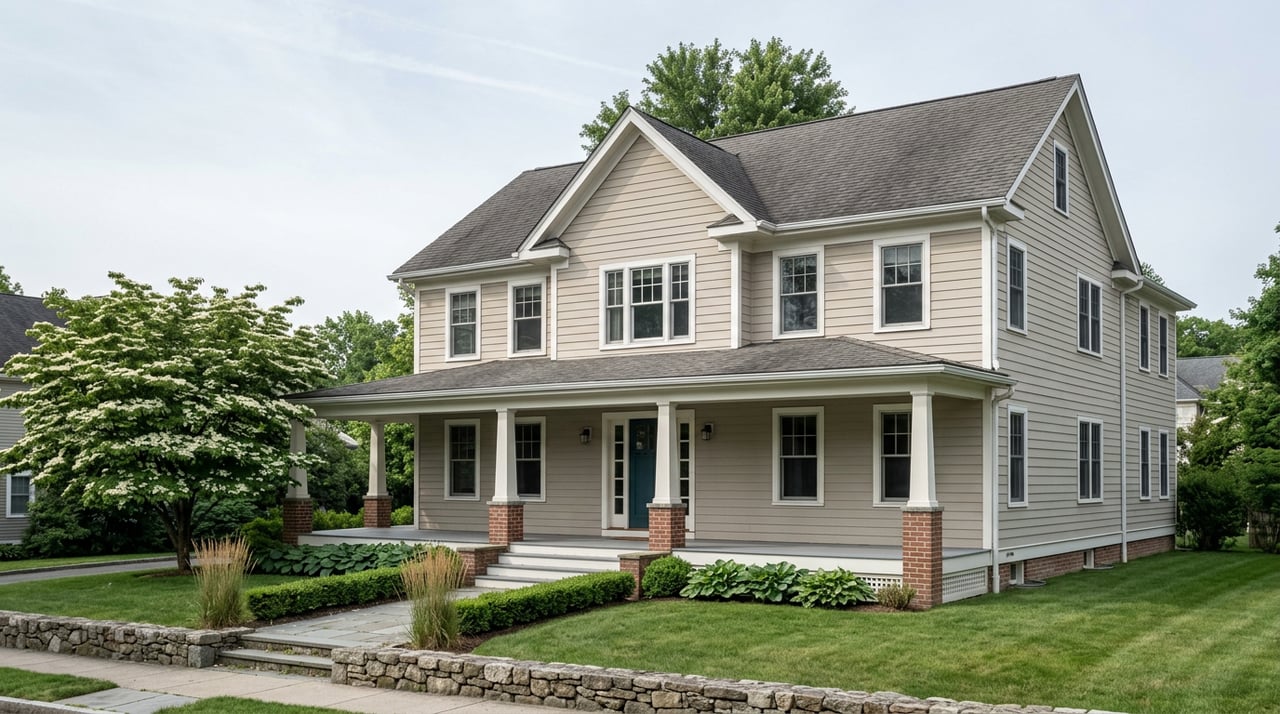
Walk one block up Lincoln Street from the park and the houses start telling a more granular story. At 98 Lincoln Street stands the Azro Coburn house, built in 1908. A few doors down at 104 Lincoln, the James Ramage house dates to 1895. At 118 Lincoln, the John Williams house, a Queen Anne built in 1893, belonged to a carpenter and painter who worked out of a downtown store. These are solid, well-kept homes built by and for tradespeople. Nobody reviews what happens to their trim.
Two blocks away, the rules change
Fairfield Avenue tells a different story, and it was always meant to. The street was laid out with a landscaped median, and it drew a different class of buyer from the start: contractors, bank officers, mill executives. Houses at 70 through 74 Fairfield Avenue, the Aaron Bagg log cabin, the Aaron Clark Bagg house, and the Roswell M. Fairfield house among them, went up in the late 1880s and early 1890s in a run of Queen Anne construction. Leslie B. White, a contractor and carriage dealer, designed several of the houses himself before moving to Westfield by 1897. Just across Northampton Street, opposite the row, wire manufacturer George W. Prentiss built a home around 1884; Prentiss went on to serve as president of both the Holyoke Savings Bank and the Holyoke National Bank, treasurer of the Holyoke & Westfield Railroad, and a director of the Holyoke Public Library.
In 2007, the city made that difference official. Fairfield Avenue became Holyoke's first Local Historic District, established under Massachusetts General Law Chapter 40C. A seven-member Local Historic District Commission was appointed to review any exterior change to the covered properties, which run along 1 through 74 Fairfield Avenue and reach into stretches of Nonotuck, Pearl, and Pleasant streets nearby, roughly fifty structures in total. The commission still meets monthly, and it holds public hearings whenever an owner wants to alter a facade, a roofline, or a window.
No other street in the Highlands has that. Lincoln Street's Victorians are just as old and, in most cases, just as architecturally intact. They simply were never organized into a protected district, so an owner there answers to nobody but the building code.
What the split actually changes for a homeowner
This is not an abstract distinction. If you buy a house on Fairfield Avenue and want to replace a porch railing, repoint brick, or put in new windows, you submit a plan to the commission and wait for a public hearing before you touch the exterior. If you buy the nearly identical Victorian two blocks over on Lincoln Street, you do the work whenever you like. Both houses might be the same age, the same style, worth roughly the same on paper. The maintenance and renovation timeline is not the same at all.
It cuts the other way too. The commission's oversight is also what has kept Fairfield Avenue's median and its run of intact facades looking the way they did in 1891, a version of the street that Lincoln Street or Kennedy Park's block never had reason to preserve on quite the same terms. If continuity of streetscape matters to you as a resident, one block delivers it by rule. The other delivers it, when it happens, by luck.
Living with the line
None of this shows up on a map you'd casually glance at, and neither the city's parks page nor the historic commission's page volunteers the comparison. You only notice it by walking the two blocks and asking why one set of houses looks frozen in time while the other has clearly been renovated house by house, decade by decade, without anyone's approval.
If you already live in the Highlands, it is worth knowing which side of that line your own house falls on, especially before you plan a project that touches the outside of the building. If you are weighing a move into the neighborhood and care about long-term streetscape, or about how much say you will have over your own exterior, that distinction is worth more than the listing photos.
Shelly Hardy has spent more than a decade working homes throughout Northampton, Easthampton, and the surrounding Pioneer Valley, including the kind of neighborhood-level detail that separates one block from the next. Schedule a free consultation if you want to talk through what a specific address in the Highlands, protected or not, actually means for your plans.